

CHIASMA Project Partners from the KIST Europe Forschungsgesellschaft mbH have published a paper entitled ‘High-throughput heart rate monitoring in Daphnia magna for sublethal ecotoxicological assessment’ (DOI: https://doi.org/10.1016/j.jhazmat.2026.141474), in which the authors demonstrate the improved sensitivity, reproducibility, and ecological relevance, offering a rapid, non-invasive, and probabilistic tool for early detection of sublethal stress in next-generation environmental risk assessment.
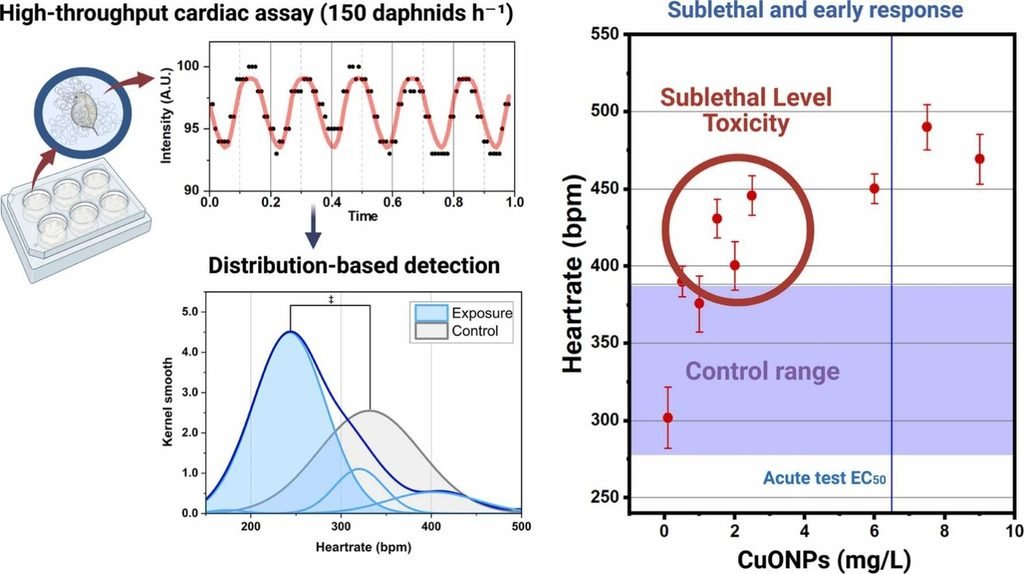
Graphical Abstract
The authors present an optimised heart rate monitoring system that addresses these limitations. By integrating a stress-minimised immobilisation method with automated real-time image analysis and Fourier-based signal extraction, the approach enables simultaneous, non-invasive heart rate monitoring of multiple D. magna individuals. This system enhances data throughput and analytical consistency. It also supports distribution-aware interpretations of cardiac responses using kernel density estimation (KDE) and Gaussian peak deconvolution, allowing for the detection of early sublethal toxic effects that may be overlooked by mean-based approaches. Therefore, this work establishes a scalable and statistically robust framework for aquatic cardiac monitoring, representing a significant advancement towards next-generation environmental risk assessment tools capable of detecting pollutant-induced sublethal effects at the population level.
The high-throughput system enabled simultaneous heart rate monitoring of up to 150 D. magna individuals per hour. Using automated Fourier-based signal recovery, the system generated consistent recordings of cardiac activity.
The authors conclude that the high-throughput heart rate monitoring system for D. magna enables the simultaneous assessment of 150 individuals per hour while maintaining stable cardiac activity (353.0 ± 57.2 bpm, compared with 457.1 ± 96.3 bpm under conventional immobilisation), thereby advancing ecotoxicological testing at sublethal concentrations and for low-toxicity substances. The generation of large-scale datasets allows for distribution-based and probabilistic analyses, moving beyond conventional mean-based endpoints and revealing population-level heterogeneity that would otherwise remain obscured. These advances provide a more comprehensive understanding of sublethal toxicity and support more accurate environmental risk assessment, as the method successfully detected significant cardiac alterations for CuONPs even below the EC10 level and distinguished subtle responses to AuNPs at NOEC-range concentrations through probabilistic, distribution-based analysis.
It is believed that the finding have strong implications for environmental risk assessment, since sublethal physiological endpoints serve as early warning indicators that are frequently overlooked by conventional immobilisation assays. The study presents a high-throughput cardiac monitoring platform for Daphnia magna, capable of detecting responses at concentrations below the no-observed-effect concentrations. By enabling population-level analysis across large sample sizes, the method addresses critical limitations in ecological risk assessment, particularly for evaluating emerging contaminants such as nanoparticles and micropollutants that are difficult to assess using immobilisation-based endpoints. The approach can thus complement existing test guidelines and offers potential as a next-generation screening tool for sensitive, non-invasive evaluation of emerging pollutants in aquatic environments.
Follow this link to download the full paper: https://doi.org/10.1016/j.jhazmat.2026.141474.
Ik Hwan Kwon, Youngsam Kim, Si-Eun Sung, Shinhye Park, Gisu Park, Sunlin Ko, Yong-Hyeon Yim, Gizachew Betru Tegegn, Sang-Won Lee, Min Beom Heo, Tae Geol Lee, Young Jun Kim,
High-throughput heart rate monitoring in Daphnia magna for sublethal ecotoxicological assessment,
Journal of Hazardous Materials,
Volume 505,
2026,
141474,
ISSN 0304-3894,
https://doi.org/10.1016/j.jhazmat.2026.141474.
(https://www.sciencedirect.com/science/article/pii/S0304389426004528)